Post
Morning vs Night Skincare Routine
May
The Chrono-Cosmetic Revolution: Morning vs Night Skincare Routine
In the world of 2026, we no longer view skincare as a mere vanity project or a superficial layer of “paint” for the face. Instead, it has evolved into a sophisticated branch of chronobiology. Science has revealed that our skin—the body’s largest organ—operates on a precise internal clock known as the Circadian Rhythm.
This biological metronome dictates when your skin is in “defense mode” and when it switches to “regeneration mode.” Using the same products for both morning and night is not just a missed opportunity; it is a fundamental misunderstanding of your skin’s metabolic needs. To achieve a truly resilient, glowing complexion, one must harmonize their skincare routine with the sun and the stars. Morning vs Night Skincare Routine
1. The Morning Philosophy: The Invisible Shield Morning vs Night Skincare Routine
From the moment the first rays of light hit your retina, your skin prepares for battle. During the day, the skin’s primary function is protection. It thickens its barrier and increases sebum production to guard against an increasingly hostile environment.
The Enemies of the Daylight
In 2026, the skin faces a “triple threat”:
UV and HEV (Blue Light) Radiation: Beyond the sun, our constant interaction with digital screens contributes to “digital aging,” causing oxidative stress that breaks down collagen.
Particulate Matter (PM2.5): Urban pollution consists of microscopic particles that can penetrate pores, leading to chronic inflammation and “inflamm-aging.”
Oxidative Stress: Free radicals from the environment act like microscopic “darts,” damaging skin cell DNA.
The Strategic Morning Routine
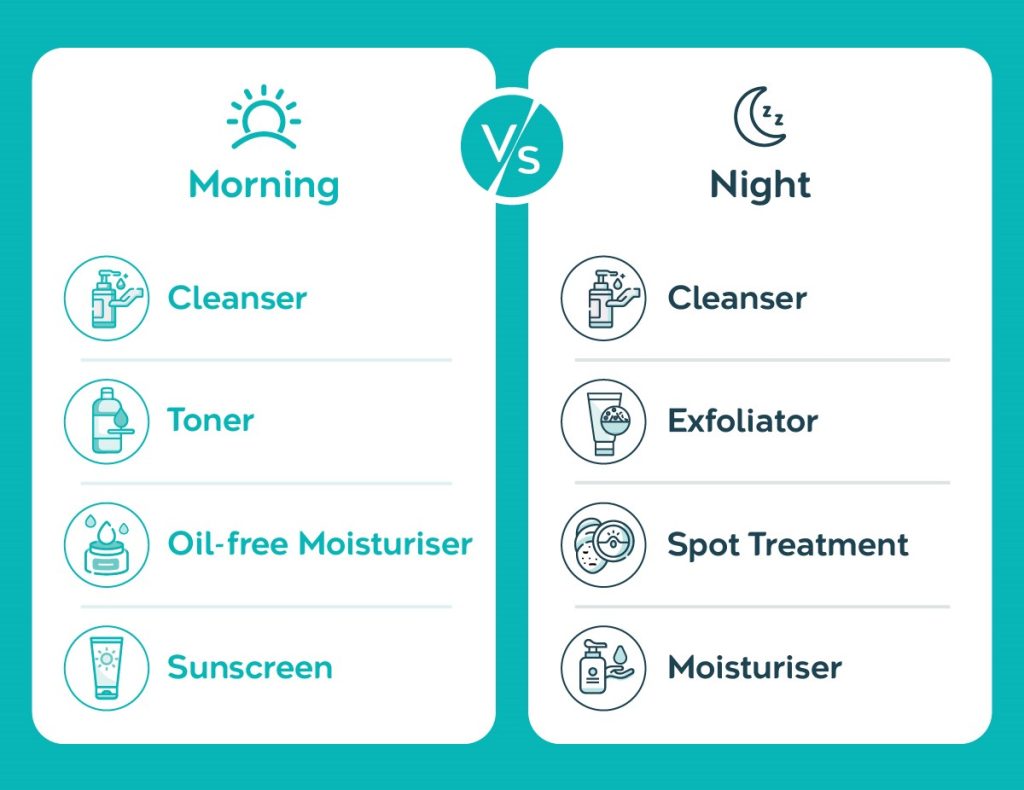
A morning routine should be lightweight, breathable, and fortified with antioxidants.
Gentle Physiological Cleansing: You don’t need to “scrub” in the morning. A gentle, pH-balanced cleanser removes the residue of nighttime products and excess sebum without disrupting the acid mantle—your skin’s first line of defense.
The Antioxidant Serum: This is your internal armor. Ingredients like Vitamin C (L-Ascorbic Acid), Vitamin E, and Ferulic Acid work synergistically to neutralize free radicals before they can damage your cells. In 2026, we also see the rise of Niacinamide in morning routines to regulate oil and brighten the complexion.
Barrier-Supportive Hydration: Morning moisturizers are now formulated with hyaluronic acid and polyglutamic acid to lock in moisture without the “greasiness” that interferes with daily life. Morning vs Night Skincare Routine
The Non-Negotiable: Adaptive Sunscreen: In 2026, sunscreen has evolved. We now use “Smart SPFs” that not only block UV rays but also contain enzymes that help repair DNA damage in real-time. Whether it’s a mineral shield or a chemical filter, this is the single most effective anti-aging product in your arsenal.
2. The Nighttime Philosophy: The Great Regeneration
When the sun sets and your body prepares for sleep, your skin’s behavior shifts 180 degrees. This is the Season of Repair. Blood flow to the skin increases, and the rate of cell division (mitosis) peaks, usually between 10 PM and 2 AM. However, there is a catch: Transepidermal Water Loss (TEWL) also increases at night, meaning your skin loses moisture much faster while you dream.
The Power of the Double Cleanse
The nighttime routine begins with a clean slate. Throughout the day, your skin has collected a “film” of oxidized sebum, heavy sunscreen, pollutants, and perhaps makeup.
Step 1: The Lipid Phase: An oil-based cleanser or balm dissolves oil-based impurities.
Step 2: The Water Phase: A traditional cleanser removes water-based debris.
This process ensures that your expensive “active” ingredients aren’t just sitting on top of a layer of urban grime.
The “Active” Window: Resurfacing and Rebuilding
Because the skin is more permeable at night, it is the only time to use potent, light-sensitive ingredients.
The Gold Standard: Retinoids: Retinol and its more potent cousins (like Retinaldehyde) are the architects of the skin. They signal the cells to turn over faster, smoothing wrinkles and clearing acne. In 2026, “encapsulated” technology allows these ingredients to be released slowly overnight, minimizing irritation.
Peptides and Growth Factors: These are the messengers. They tell your skin to produce more collagen and elastin, reinforcing the structural “scaffolding” of your face.
The Sealant (Occlusives): To combat the nighttime moisture loss (TEWL), night creams are richer and contain Ceramides, Fatty Acids, and Cholesterol. These lipids mimic the skin’s natural barrier, “sealing” the moisture in so you wake up plump, not parched.
3. Ingredient Synergy: What Goes Where?
Understanding chronobiology allows you to avoid “ingredient conflict.” Some ingredients cancel each other out, while others work better in specific light conditions.
| Ingredient | Best Time | Why? |
| Vitamin C | Morning | Boosts SPF effectiveness and fights daytime free radicals. |
| Retinol | Night | Degrades in sunlight and increases sun sensitivity. |
| AHAs/BHAs | Night | Exfoliates dead cells, making skin more susceptible to UV damage if used in the AM. |
| Hyaluronic Acid | Both | Keeps skin hydrated regardless of the environmental state. |
| Ceramides | Night | Rebuilds the barrier during the peak repair cycle. |
4. Modern Trends: The Shift Toward Barrier Health
The 2026 skincare consumer has moved away from the “more is better” approach. We have seen the damage caused by over-exfoliation and the “stripping” of the skin. Today’s trend is Barrier-First Skincare.
The “Skin-Biotics” Movement
We now recognize that our skin is home to a thriving ecosystem of beneficial bacteria: the microbiome. Modern routines often include prebiotics and postbiotics to nourish these “good” bacteria, which in turn protect us from pathogens and inflammation. A healthy microbiome is the secret to the “Glass Skin” look—it provides a natural radiance that makeup cannot replicate.
Customization and AI Diagnostics
In 2026, many consumers use AI-powered skin analysis tools to adjust their routines based on daily factors like local humidity, pollution levels, and even menstrual cycles. This “Precision Skincare” ensures that if the air is particularly dry on a Tuesday, your routine adapts to provide more occlusives that night.
5. The Holistic Connection: Sleep, Stress, and Skin
Circadian skincare isn’t just about what you put on your face; it’s about how you live. The “Brain-Skin Axis” is a major focus of 2026 wellness.
Cortisol and Collagen: High stress levels produce cortisol, which actively breaks down collagen. A morning meditation or an evening wind-down ritual is as much a “skincare step” as applying a serum.
Melatonin: This isn’t just a sleep hormone; it is a potent antioxidant that the skin produces locally to repair itself. Deep, uninterrupted sleep is the most effective (and free) beauty treatment available.
6. Strategic Consumerism: Buying with Purpose
The savvy 2026 consumer avoids “hype-buying.” By categorizing products into Defense and Recovery, you can build a streamlined, effective shelf.
Invest in the Day: Spend your money on a high-quality, stabilized Vitamin C and a cosmetically elegant, high-protection sunscreen. These are your long-term insurance policies.
Invest in the Night: Spend your money on high-performance actives like Retinoids or Peptides, and a rich, barrier-repairing cream. These are your “mechanics” that fix the damage while you sleep.
Conclusion: Harmonizing with Your Biology
The path to exceptional skin in 2026 is paved with consistency and biological awareness. Your skin is a dynamic, living shield that breathes with the rhythm of the planet. By tailoring your morning routine to Protect and your nighttime routine to Repair, you are no longer fighting against your biology—you are harmonizing with it.
Skincare is a marathon, not a sprint. It is a daily ritual of self-respect. When you align your beauty habits with your body’s natural 24-hour cycle, you achieve more than just a clear complexion; you achieve a state of physiological balance that radiates health, confidence, and resilience.
The invisible signature of a well-maintained circadian routine isn’t just “good skin”—it is the unmistakable glow of a body in perfect harmony.
